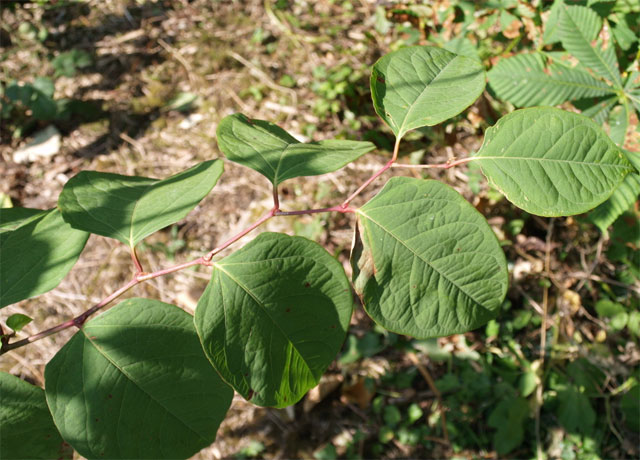

The British Isles are host to many hundreds of wild, foreign plants, ‘invasive aliens’, introduced mostly by human action. The more aggressive are termed ‘High-impact Aliens’. Examples are Japanese Knotweed, Himalayan Balsam, Giant Hogweed, Pygmyweed, Rhododendron and Laurel.
Bernards Heath proper has had two (connected) occurrences of Japanese Knotweed in the 21st century, the last in 2016. The Friends dealt with it on the second occasion, and we wait to see if success was absolute.
Rhododendron, a native of Turkey and S-W Spain and Laurel, from S-E Europe, are similar in that (in this country) they eventually monopolise the under-storey of woodland to the exclusion of all other flora and thus all animal and bird life. The woodland floor becomes a sterile monoculture.
Since the end of brick-making on the Heath at the beginning of the 20th century, Nature has reclaimed most of that ‘brownfield’ land and it is now classified as Secondary Woodland i.e. not Ancient Woodland. Fortunately, native tree species have made good claim to the available space and aliens are not dominating so far, although it could be argued that sycamore is less than welcome as it is not a true native.
We are thankful that Rhododendron is not in evidence on the Heath and that Laurel, while present, is in what we judge to be manageable amounts. The one, notable occurrence of Laurel on the E side of Harpenden Road, against the S end of the fire station site, has been successfully eliminated within recent times.
Laurel is thus to be found principally on the W side of Harpenden Road and we have commenced a campaign to deal with it. The procedure with the larger thickets will be to cut down to ground level and then monitor in successive years, lopping-off re-growth as it appears. This procedure worked well by the fire station and the stumps gave up re-growth surprisingly readily. Grubbing-out would be difficult amongst tree roots.
Smaller bushes can be ‘weeded’ out and then monitored for any re-growth. Self-set new growth, originating with seed from outside BH will have to be continually watched-out for, but is easily removed when very young.
We are not able to engage in Laurel control during the Nesting Close Season, from the beginning of March to the end of August.