A walk around the parish of St Saviour’s, Sandpit Lane conducted by local historian Peter Burley.
Meet at the hall, 25 Sandpit Lane at 2.00 pm on Sunday 19th February.
The walk will be followed by tea and a talk in the hall at 3.30 pm. You are welcome to arrive in time for the talk. It will not cover the whole boundary, that would be too ambitious, but the eastern third of the parish going from the church via the Wick and back again along Marshal’s Drive.
This is a valedictory event for Father Peter at St Saviour’s and all are welcome.
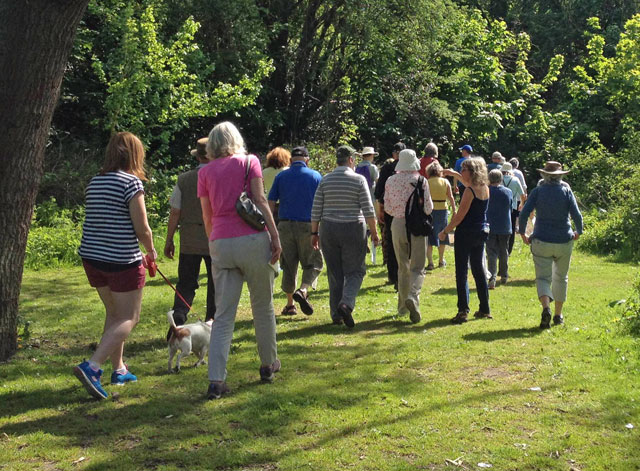
The walk on the 8th May was very successful with 30 people joining on what was a sunny warm afternoon. Local historian Peter Burley led the walk, with an impressive depth of knowledge about the area.
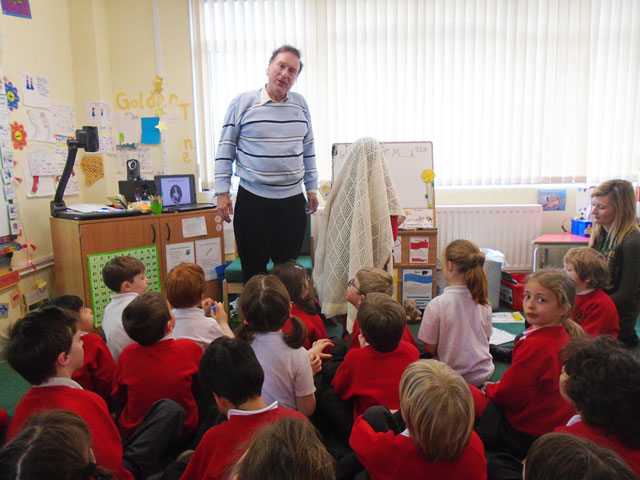
Peter Burley, a local historian and member of the Friends of Bernards Heath Committee, gave an illustrated talk focusing on what happened and what you would have seen on the school site over the centuries.
Peter Burley with children at Bernards Heath Infants School Photo: Isabel Kearns
Peter writes: We start with Julius Caesar who would have marched his army past the school in 54BC on his way to attack Wheathamstead. Shakespeare’s King Cymberlaine was king round here before the Romans returned and he built Beech Bottom Dyke. We look at how the land reverted to wild wood after the Romans and was then cleared by burning the trees to make land for pasture and creating the heath. This gives the area and the school its name – “Bernards Heath”. The name means land cleared by burning and is the same derivation as “Barnet” or “Brent”. The first map of the area calls it “Barnet Heath”, and, rather alarmingly, shows the town gallows standing opposite the school.
We look at how the Manor of Sandridge – and hence the school site – passed from control by the Abbey to control by the Spencer family (whose name is commemorated in the school) – via the Duke and Duchess of Marlborough, who rescued the commons along Harpenden Road from being enclosed. The local economy was based on brick making into the 19th century and we look at where there are some surviving brick pits opposite the school. The pits that filled up with water and where kids from the school actually drowned have long since been filled in.
Photo: Isabel Kearns
We finish the history with the area being built up and the school founded in the 1890s, but not before re-enacting the story of the most romantic character to have been associated with the area. A volunteer girl from the class is draped in a white cellular blanket to illustrate the story of the “Lady in White”. She was Frances Jennings, Countess Tyrconnel, who lived 1647-1730. She was born at Waterend House but then grew up in London, where, as a child, she ran away from home to sell oranges in Covent Garden. She and her two sisters inherited a bankrupted estate which included the Manor of Sandridge. Her older sister (Sarah) married the future Duke of Marlborough and restored the family’s fortunes. Frances married Richard Talbot, a Roman Catholic, who was created Earl Tyrconnel* by James II and then led the Irish in opposition to William III’s invasion in 1689. He died of a stroke before his brother-in-law could complete the conquest of Ireland and Frances fled into exile at the Court of Versailles. After being initially feted by Louis XIV, she fell on hard times as France went bankrupt and she was reduced to living as a beggar in Paris. There she used lace-making as a prop for her begging and sat on the pavement weaving lace while dressed head to foot in white lace so no one could see her face. She also became deranged. At a later date she returned to London under an amnesty for Catholic exiles and continued her lace-making and begging in Covent Garden. There she became a tourist attraction in her own right and was known as the (anonymous) “Lady in White”, but she never returned to Sandridge.
*as a footnote, he features in the nowadays little-sung words to the song “Lilly Bolero”, where he is portrayed as an ogre who eats Protestant babies.